MORE NEW WORLDS
AWAIT DISCOVERY
philip e daoust
FOLLOWING A YEAR of
discovering new planets, San Francisco State University
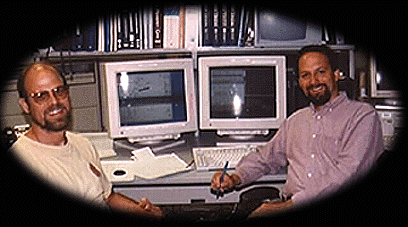
researchers Geoffrey Marcy and Paul Butler say they won't
be announcing additional findings any time soon.
"I don't have time for any
research any more," Marcy said. "So, no new
planets will be found by Paul Butler or me for many
months, perhaps years." Marcy said they spend most
of their time now responding to media requests--as many
as 20 per day.
Butler said he will continue to analyze
data collected over the summer but that it may be a year
or more before any new findings are announced. He's
confident, however, that more planets will be discovered.
"Over the next five years maybe we
will find another 50 to 100 planets," he said.
Endless Number
Astronomers now believe that there may
be an endless number of planets in the universe, many
that will never be found and others that could challenge
conventional theories of how planets are formed and how
the universe itself came to be.
"The galaxy has a 100 billion or
there-about stars, so you can expect there would be many
hundreds of millions of planets. We are obviously in the
very early stages of scoping them out."
Furthermore, Butler said no less than
five percent of all stars have large, Jupiter-size
planets orbiting them. "I would guess that most
stars have planets," he said, adding that many of
those could be Earth-size or smaller.
Last year the team confirmed the
first-ever planet found outside our solar system. The
initial discovery of a planet orbiting the star 51 Pegasi
was made by a pair of Swiss scientists. But they were
unsure if the large object orbiting 51 Pegasi, a star
about 55-60 light years from earth, was a brown dwarf (a
huge star mass) or a large planet.
Only with a fine-tuned technique,
sophisticated computer programs and close analysis were
Butler and Marcy able to determine that it was indeed the
first planet to have been discovered outside our
planetary system.
They used a technique called
"wobble velocity" to do their analysis. Wobble
velocity is similar to Doppler Shift. Wobble does not
guarantee the presence of an orbiting planet--many stars
wobble. But it's the first variable examined when making
a determination. The final determination is made through
complex analysis of data collected from a star's
wobble--rate, extent, frequency of wobble, etc.
The finding launched the California
scientists into the world spotlight, but it was only the
beginning of their extra-solar planet treasure hunt. Over
the ensuing months, they independently discovered five
new planets.
Latest Discovery Raises Age-Old
Question
Last month Marcy and two astronomers
from the University of Texas confirmed they had found an
eighth extra-solar planet some 85 light years from Earth.
The newest planet, found orbiting the
star 16 Cygni B, apparently has an eccentric orbit. Its
orbit is elliptical, unlike any other orbit known to
exist in the Milky Way galaxy.
Scientist are also excited about the
giant planet's distance from its star--far away enough to
be neither too hot nor too cold--raising the possibility
that it could contain liquid water, the essential
ingredient for life on Earth.
The possibility of life existing on
other planets is not far reaching, Butler said,
especially if water is present.
But it will be years, if not decades,
before scientists can get a better idea of the
composition of these distant planets. Butler said two or
three of the planets they have discovered are so
positioned that water could exist in liquid form.
The string of extra-solar planet
findings has given renewed legitimacy to the search for
life elsewhere in the universe.
In August, NASA stunned the world when
it announced that a meteorite found in the Antarctica,
and believed to have come from Mars, possibly contains a
fossil micro organism. If the finding is true, it could
lead to scientists discovering life on Mars and give
credibility to calls for further probes into outer space.
However, Butler, like many scientists,
is skeptical of the Mars discovery.
"I don't necessary believe that
they actually found remnants of life in those
rocks," he said, "but I don't discount it
either." Butler said more information is needed to
make any theories about life existing on Mars, but he did
say there is "no question" the red planet once
contained running water.
"The possible Mars discovery of
life really doesn't affect our detection of
planets," Marcy said. "But, if Mars did once
harbor life, then it is extremely likely that planets
outside our solar system would also develop the
biochemistry of replicating molecules and leading to
Darwinian evolution."
Yet the planet finders have nothing to
do with the search for life in outer space, Butler said.
"We are not searching for any kind of life. Heck, we
wouldn't even know how you go about doing it."
NASA Renews Own Search
Marcy and Butler's findings, combined
with the Mars rock discovery, have spurred NASA
researchers to renew proposals to expand their own search
for extra-solar planets.
John McDonald, a researcher at the SETI
Institute based at NASA's Ames Research Center in
Mountain View, Calif., said he and fellow astronomers
want to search for smaller planets outside our solar
system--planets which are more Earth-size than the larger
ones Marcy and Butler have been finding. Those discovered
by Marcy and Butler are Jupiter-size and larger.
"Marcy and Butler's work is
parallel to ours, and doesn't actually change our mission
plans. Their work, however, strongly supports the
likelihood that if there are large planets, like the ones
they have discovered, there are probably small Earth-like
planets as well," said McDonald.
Unlike Marcy and Butler's technique,
the NASA scientists will measure "brightness
variations" of many stars, McDonald said. They will
look for a "dip" in the light emitted from a
star as a planet passes in front of it.
"By observing many stars
simultaneously, we should detect a wide variety of
planets, some of which will be in the so-called
'habitable zone' around each star, where liquid water,
thick atmospheres and possibly life will exist."
World's Largest Telescope
Butler and Marcy have collected an
enormous amount of data from their continued observations
at the Lick Observatory east of San Jose and the Keck
telescope on the 14,000 foot summit of the Mauna Kea
volcano in Hawaii. The Keck is the world's largest
telescope.
Astronomers from around the world dream
of getting a chance to look at the universe through the
Keck's super-powerful lens. NASA has reserved time for
the two researchers on the telescope this year and next.
"A few years ago NASA kicked in 30
to 40 million for time on the Keck and now have about 90
to 100 nights reserved for the next year," Butler
said.
Using the Keck telescope, the
planet-finding team is able to collect data from
approximately four hundred stars, compared to about one
hundred at the Lick. The data collected will continue to
be analyzed by Butler, Marcy and a few graduate students
working with them on their cosmic search.
"This telescope permits us to
observe 400 Sun-like stars," Marcy said, "and
enables detection of Saturn-like planets, in addition to
the Jupiter-like planets that we have already
found."
Observatory in Space
Within the first decade of the next
century, NASA has said it plans to launch a huge platform
deep into outer space that would contain powerful
telescopes capable of blocking out the light glare from
certain stars, allowing astronomers to focus in on the
planets orbiting them.
Butler is enthusiastic about the
project because of the possibility of looking at the
planets he and Marcy have discovered. "The prospects
are exciting," he said. "Taking a spectrum of
the planet allows you to figure out its
composition."
While the scientists know that the
newly found planets are indeed planets--and not something
else, like huge star masses--they have never actually
seen them. The planets are too far from Earth for current
telescopes to detect.
"All we actually see," said
Butler, "is the velocity wobble that the planet
imposes on the parent star, so we don't know what these
planets are made of. What we know is the orbit of the
planets, and that we know quite precisely."
|